The morning of 28 June 2025, a Saturday, our staff WhatsApp groups went quiet in a way they usually didn't. The day before, the Ministry had published the notification reclassifying cannabis flower as a controlled herb under the Traditional Thai Medicine framework. Everyone had seen it land. Nobody quite knew what to say first.
Tourists kept walking in that morning like nothing had happened. Most hadn't read a Thai gazette over breakfast. They wanted the same thing they wanted on Friday — a few grams, a couple of pre-rolls, a chat with whoever was on shift. We served them. We also started explaining, gently, that things were about to look different.
This is what the last twelve months have actually looked like from inside the shop.
The First Few Weeks Were Mostly Quiet Confusion
You'd expect more drama. There wasn't much. The new rule didn't shut anyone down on Day 1 — it tightened the framework around what was already happening. The PT33 prescription requirement was the headline change, but the practical effect rippled out slowly. Most shops kept their doors open. Most customers kept walking in. The conversation at the counter just got longer.
What did happen was a slow split among operators. Some treated the rule as temporary — bet that political winds would shift again within months, and just kept operating as before. Others assumed the new framework was permanent and started rebuilding their setup around it. We were in the second group. That decision turned out to matter more than anything else we did that year.
The operator chat groups went from constant to quiet to active again over about six weeks. The quiet stretch was when people were figuring out what to do. The new wave of activity was the survivors comparing notes — who was issuing PT33s on-site, who was outsourcing to clinics, who was waiting to see, who'd already started liquidating stock.
Why Some Shops Closed and Others Didn't
The closures weren't all about compliance. Most of them came down to economics that had nothing to do with the new rule.
A lot of the shops that opened during the 2022–2024 boom never had real margins. Cheap leases that were expiring. Inventory bought on inflated 2022 wholesale prices that they were still trying to move at 2025 retail prices. Owners who weren't operators — passive investors who'd never had to run a real business. Once the new compliance overhead hit — staff training, documentation systems, the cost of setting up legitimate medical infrastructure — a lot of them just didn't have the cash or the will to make it through.
The shops that survived tended to share a few things: actual operators on the ground, conservative stock management, and a willingness to spend on compliance before being forced to. Not because anyone is heroic. Just because those are the businesses that were going to make it through a tightening regulatory environment in any industry, anywhere.
The most painful conversations of late 2025 weren't with regulators. They were with friends in the industry who couldn't make the new numbers work. Some closed quietly. A few moved their inventory across borders and never came back. The rest of us tried to absorb their best staff.
What Compliance Actually Looks Like Day to Day
The headline version of the PT33 requirement makes it sound dramatic. The reality, after we got our systems in place, is dull. Which is the goal.
At each Stash BKK branch, an eligible customer can ask staff to facilitate a telemedicine assessment with an authorised Thai practitioner, subject to availability. It typically takes 10–15 minutes and costs 100 THB. The practitioner conducts a genuine medical assessment and independently decides whether a PT33 is medically appropriate; the shop does not issue it. Any dispensing then follows the current licence, prescription, product, and quantity requirements.
The first month of running this, every step felt slow. By month three it was muscle memory. By month six the tourists who'd visited in 2023 were coming back, telling us they'd been worried it would feel medical or clinical, and admitting it didn't. That's the work that mattered — making compliance disappear into the visit.
Things we changed permanently:
- Staff training is heavier. Bud tenders need to know enough about the consult flow to set customer expectations before they pick up the tablet.
- Inventory is documented at every step. Audits became routine rather than dreaded.
- Marketing got narrower. Anything that could read as "selling cannabis recreationally" got cut from our communication. We talk about flower, we talk about kratom, we talk about the shop. We don't talk about getting high.
- We stopped some product categories entirely. Anything that wasn't clearly inside the licensed framework — gone. Not worth it.
What the Customer Side Has Felt Like
Most of the customer pushback we expected didn't materialise. Tourists who walked in for the first time in July 2025 didn't know it was supposed to be harder, so the 15-minute consult felt normal to them. Regulars who came back after a few months were the ones who needed re-explaining — "wait, I need a prescription now?" Yes. "Is that a big deal?" No.
The questions that come up most:
- Do I qualify for a prescription? — In our experience, anyone reporting common wellness concerns (sleep issues, chronic pain, anxiety, appetite) qualifies. The practitioner makes the call.
- Does my passport work? — Yes. The system was built with foreign visitors in mind.
- Can I take it home? — No. Exporting cannabis from Thailand is illegal regardless of the prescription. We say this every visit, sometimes twice.
- Will the law change again? — Probably, slowly, in directions nobody can predict from here. We tell people what we know, which isn't more than the press knows.
Where Things Sit in Mid-2026
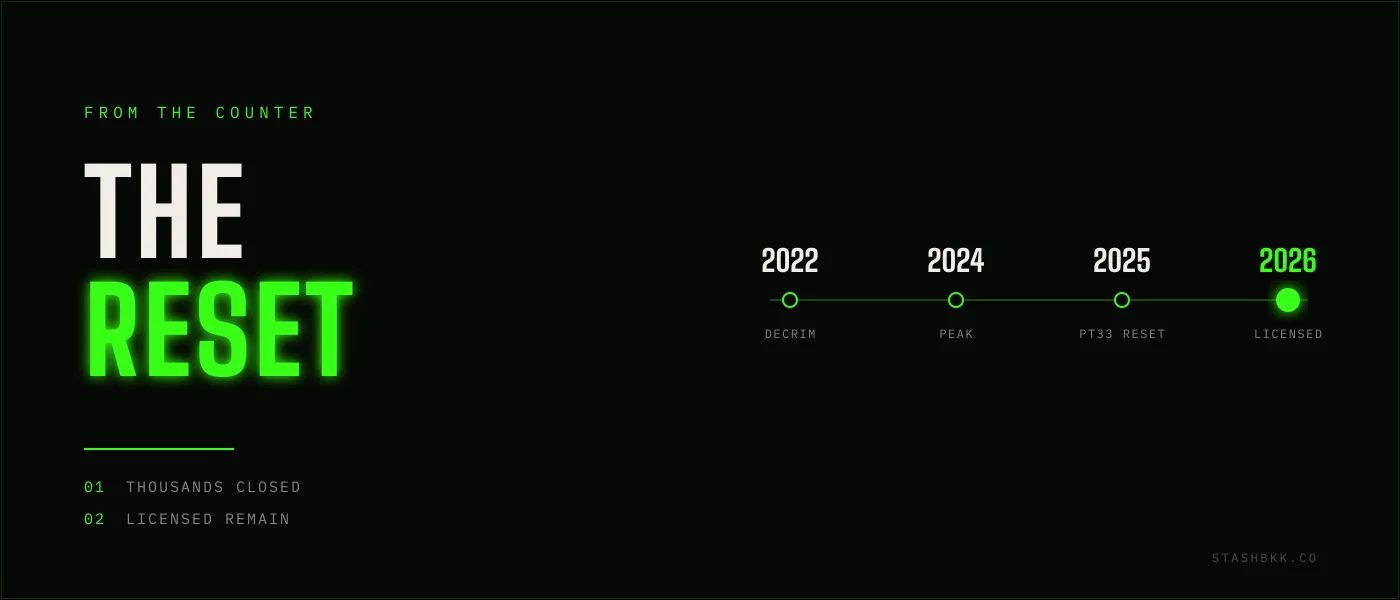
The industry is smaller, quieter, and more professional than it was in 2024. Bangkok still has thousands of licensed dispensaries — not the 18,000 figure from the peak, but a real network. The shops still running tend to be ones that took the medical framework seriously rather than waiting for it to disappear.
Stash BKK Chinatown permanently closed on 1 September 2026, after its final trading day on 31 August. The three current Stash BKK locations are On Nut, Ari and Ekkamai; all are open 24 hours. Current addresses and directions. When this operator account was first published in May 2026, walk-in volume had been steady, with the mix shifting slightly — more medical-curious local customers, more well-informed tourists, fewer of the "is this actually legal" first-timers we used to spend twenty minutes reassuring. That observation describes the period before publication, not current branch sales.
What we don't yet know is what comes next. The political backdrop has been actively shifting through 2025–2026. There's been ongoing discussion of additional requirements — physical doctors on-site at every dispensary being one possibility that's been floated. If that happens, we'll adapt. We'd rather see those rules in writing first, the way we did with the PT33 framework, before assuming what they'll require.
What We'd Tell Someone Thinking About Opening a Shop in 2026
Don't, unless you actually want to be in the cannabis business and not just adjacent to it. The 2022–2024 era where a passive investor could put up money and have a shop run itself is over. The shops that work now are the ones run by people who care enough to be there at 11pm explaining a new regulation to a tourist or 7am training a new bud tender on the consultation flow.
That's not bad news. It just means the industry has joined the rest of the economy — businesses that work hard and adapt make it; businesses that don't, don't. The cannabis exemption is over. The hospitality logic is the same one that's always applied to every other licensed business in Thailand. That's probably how it should have been from the start.
FAQ
Are cannabis shops in Bangkok still open in 2026?
Yes — thousands of licensed dispensaries continue to operate across the city. The industry is smaller than at its 2024 peak but stable. The shops that adapted to the medical framework after June 2025 are the ones still standing.
What's the biggest change for cannabis shops since 2025?
The PT33 prescription requirement. Controlled cannabis flower requires a medical prescription from an authorised Thai practitioner after a genuine assessment. Stash BKK can facilitate telemedicine during a visit, but the practitioner independently decides whether to prescribe.
Did the 2025 changes shut down a lot of dispensaries?
Many shops closed, but compliance was rarely the only reason. The bigger factor was economic — businesses with thin margins, expensive leases, and absentee ownership didn't survive the added overhead. Shops that were operationally serious to begin with mostly made it through.
Will Thailand tighten cannabis rules further?
Probably, gradually. There's been ongoing discussion of additional requirements including physical practitioner presence in shops. Nothing is confirmed for 2026. Operators expect more changes; nobody can predict the exact shape from here.
Is it still worth opening a Bangkok dispensary?
Only if you intend to operate it seriously. The barrier to entry is higher now — compliance overhead, real staff training, documented inventory. The passive-investor model of 2022–2024 doesn't work anymore.
How can I find a licensed dispensary I can trust?
Look for shops that display their current licence, explain how customers access an independent medical assessment, and never present PT33 as guaranteed paperwork. Stash BKK operates three licensed branches across Bangkok and can facilitate telemedicine assessments during visits, subject to practitioner availability and decision.