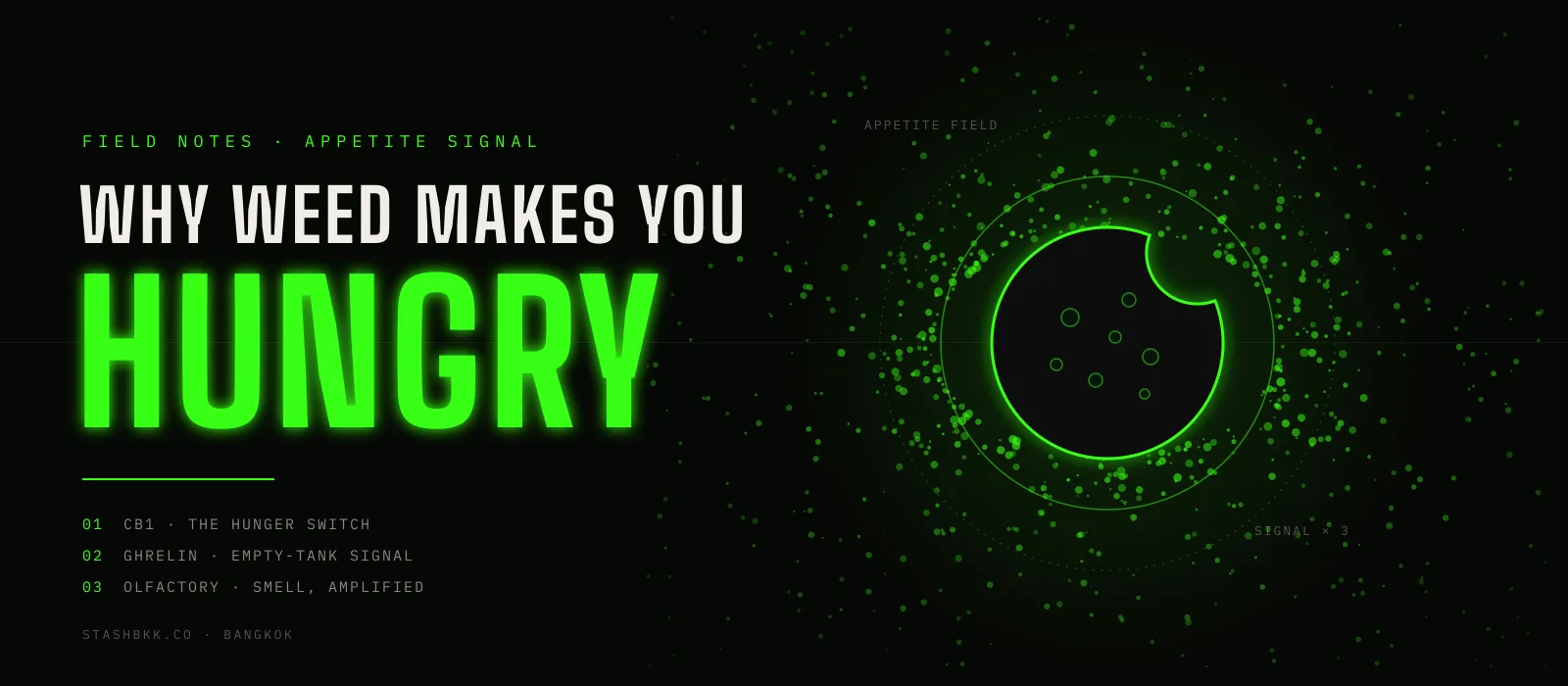
Anyone who has smoked even once knows the feeling: thirty minutes in, a plate of street pad thai you walked past without a second look suddenly seems like the most important thing in Bangkok. The phenomenon has a name — the munchies — and the question of why weed makes you hungry is one of the more genuinely interesting bits of cannabis science, because the answer isn't "you're bored and food is there." It's brain chemistry, and it's fairly well understood.

This post walks through what's actually happening when THC switches on your appetite, which cannabinoids and terpenes drive it, and — the part most articles skip — which ones quietly do the opposite. Useful whether you're trying to lean into the munchies or trying to avoid eating an entire night market.

The short answer: THC hijacks the system that tells you you're hungry

Your body has a built-in network called the endocannabinoid system — a set of receptors and signalling molecules that, among many other jobs, helps regulate appetite, mood, and how food tastes. It runs on compounds your own body makes (endocannabinoids). THC, the main psychoactive compound in cannabis, happens to fit the same receptors. When it binds to them, it nudges several appetite levers at once.

The headline effect happens in the hypothalamus, the part of the brain that governs hunger. THC there appears to flip neurons that normally tell you you're full into telling you you're hungry instead — so the "I've eaten enough" signal gets temporarily rewired into "find food." There's no actual energy deficit. Your body just thinks there is.

This isn't fringe science. Cannabis-induced appetite stimulation is well documented enough that it's used clinically — for chemotherapy patients and others where appetite loss is a real medical problem. The U.S. National Center for Complementary and Integrative Health has a plain-language overview of what cannabinoids do and don't do in the body (NIH NCCIH: Cannabis and Cannabinoids), and the appetite link shows up across decades of work indexed on PubMed.

Ghrelin, dopamine, and why food suddenly tastes better

The hypothalamus is only part of it. A few other things stack on top, and together they explain why the munchies feel less like ordinary hunger and more like a craving.

Put those together — a hunger switch flipped, a hunger hormone turned up, the reward of eating amplified, and your nose dialled to eleven — and the munchies stop looking like a quirk and start looking like an entirely predictable outcome.

Not all cannabis hits appetite the same way

Here's the part that's genuinely useful at a dispensary: the strength of the munchies varies a lot depending on what you consume. It's not random. Specific cannabinoids and terpenes push appetite up, and a few push it down.

THCV — the cannabinoid that does the opposite

THCV (tetrahydrocannabivarin) is a lesser-known cannabinoid that's chemically related to THC but behaves differently around appetite. At lower doses it's been associated with appetite suppression rather than stimulation — the anti-munchie. Strains and cultivars higher in THCV (often certain African-lineage sativas) have a reputation for a clearer, more energetic high with less of the bottomless-stomach effect. If you specifically don't want to eat everything in sight, this is the chemistry to ask about.

CBD — neutral-to-dampening

CBD on its own doesn't trigger the munchies the way THC does, and it can take some of the edge off THC's effects generally. A higher-CBD or balanced flower tends to come with a milder appetite bump than a high-THC, low-CBD one.

Terpenes that lean toward hunger

Terpenes that lean the other way

If terpenes are new to you, our piece on terpenes vs the indica/sativa label goes deeper on why the aroma profile predicts effect better than the category on the jar — and that includes how hungry a strain is likely to make you.

Before You Shop

Cannabis flower requires a PT33 medical prescription under current Thai law. Stash BKK handles this on-site via our DTAM-endorsed telemedicine platform — same hour you arrive, no separate clinic visit. Around 10–15 minutes, 100 THB. Once that's sorted, the budtenders at any branch can steer you toward a higher-THCV or humulene-forward strain if you want to keep the munchies in check, or a myrcene-heavy one if you're leaning in.

Edibles, timing, and managing the munchies

A few practical notes, since "why does weed make me hungry" usually comes bundled with "and how do I deal with it."

If you want strain-specific suggestions, our rundown of cannabis strains in Thailand is a good starting point — though as always, the menu rotates, so the right move is to describe the effect you want to the budtender rather than chase a specific name.

Where to ask in Bangkok

All four Stash BKK branches carry a wide, rotating range of flower across indica, sativa, and hybrid, so there's usually something on the shelf whether you want to feed the munchies or dodge them. On Nut, Ari, and Ekkamai run 24/7 — handy when the late-night version of this question becomes urgent — while Chinatown runs 11 AM to 2 AM in the heart of the Yaowarat food district, which is either the best or worst place to have the munchies depending on your willpower. You can see all four branches here.

Tell whoever's behind the counter what you're after — "something that won't make me eat the whole menu" or "the most relaxing thing you've got" — and the terpene and cannabinoid profile does the rest.

FAQ

Why does weed make you hungry?

THC binds to receptors in your brain's endocannabinoid system and flips appetite-regulating neurons in the hypothalamus from "full" to "hungry." It also boosts ghrelin (the hunger hormone), amplifies the reward of eating via dopamine, and sharpens your sense of smell and taste. Together that produces the strong cravings known as the munchies, even on a full stomach.

Do all cannabis strains give you the munchies?

No. High-THC strains rich in myrcene tend to bring the strongest appetite boost, while strains higher in THCV or the terpene humulene can actually blunt appetite. CBD-heavy or balanced flower usually comes with a milder munchie effect. The cannabinoid and terpene profile matters more than the indica/sativa label.

What cannabis suppresses appetite?

THCV — a cannabinoid related to THC — is associated with appetite suppression at lower doses, and is found more often in certain sativa-leaning genetics. The terpene humulene has also been linked to reduced appetite. If keeping the munchies in check matters to you, ask a budtender for higher-THCV or humulene-forward options.

How long do the munchies last?

For smoked flower, appetite effects typically track the high itself — roughly one to three hours, peaking early. With edibles the curve is longer and slower, so hunger can show up around an hour in and linger for several hours. Eating beforehand and staying hydrated both soften the intensity.

Are the munchies bad for you?

Occasional overeating during a session isn't harmful for most healthy adults — it's the same appetite mechanism used clinically to help patients who've lost their appetite. The thing to watch is habit and choice: regular late-night high-calorie binges add up like any other overeating. Plan your snacks ahead and the munchies become an enjoyable feature rather than a problem.

Does eating while high make food taste better?

Many people report it does, and there's a plausible mechanism: THC appears to sharpen smell and taste by acting on the brain's olfactory centre, and it amplifies the reward response to eating. So food isn't just more wanted — it can genuinely register as more flavourful and more pleasurable.