Most conversations about the history of cannabis in Thailand start in 2022, the year flower came off the narcotics list. Fair enough — but that skips centuries of the actual story, and the messier middle: how a plant Thai households used without much fuss got turned into a Category 5 narcotic, and how it got smuggled out of the country by the ton in the 1970s with a reputation that outlived the smugglers.
This isn't the legalization story — we cover how Bangkok became Asia's cannabis capital elsewhere, and the genetics and the "Thai stick" product get their own posts too. This is what came before: three eras behind why Thailand's relationship with cannabis is older and stranger than most people assume.
The history of cannabis in Thailand starts centuries before any dispensary
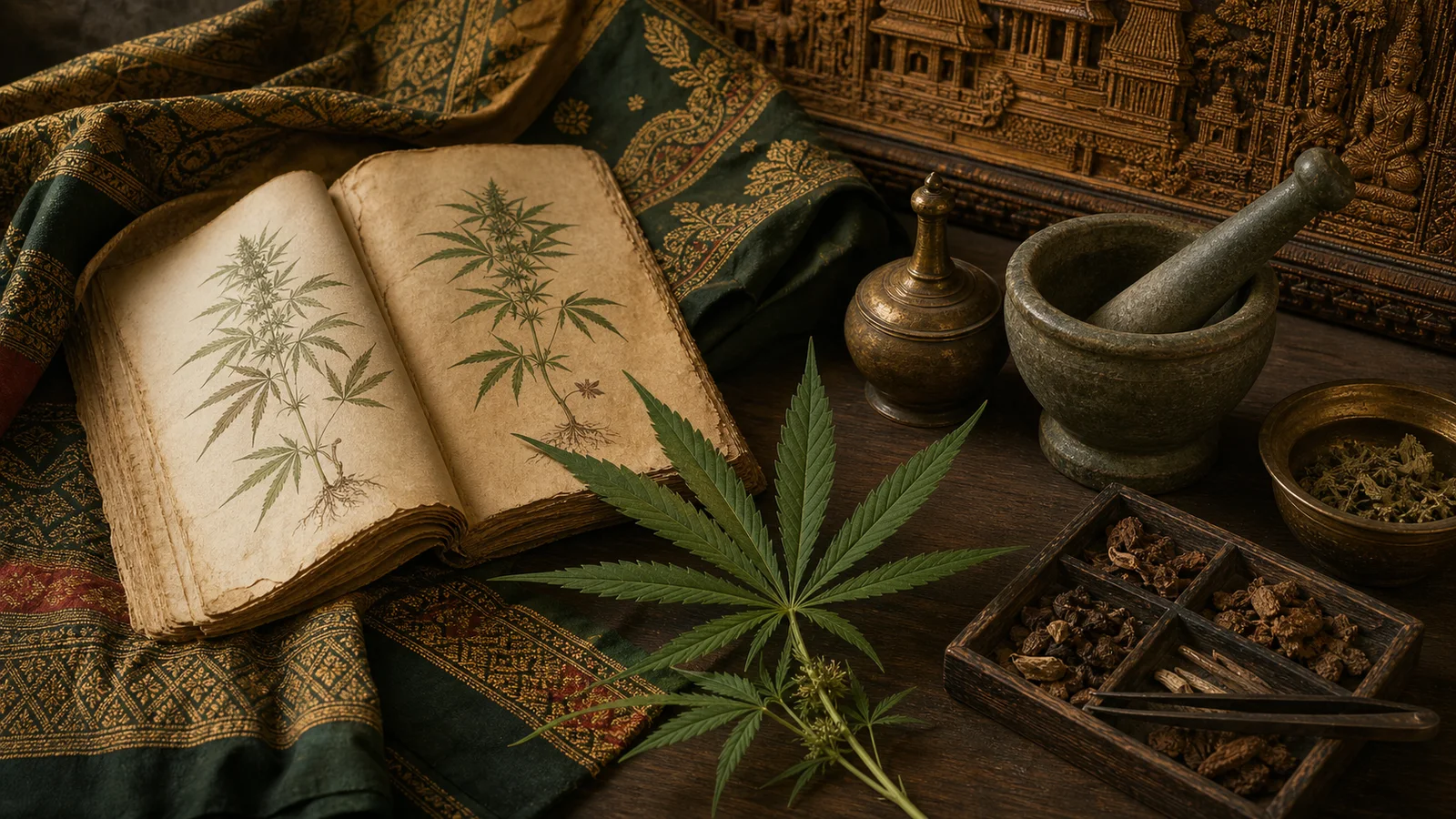
Cannabis shows up in Thai medical texts well before anyone thought to regulate it. The best-documented source is the Tamra Phra Osot Phra Narai — King Narai's compendium of medicines, compiled during the Ayutthaya period under King Narai the Great (reigned roughly 1656–1688) and republished in 1923. It runs to more than 700 herbal formulas, a meaningful number of which call for cannabis alongside turmeric, galangal, and black pepper — generally for what traditional Thai medicine grouped under "wind" ailments: muscle pain, stiffness, fatigue, poor appetite.
The formulas, by name
Some of these old formulas still have names attached: Ya Suksaiyad, for general weakness, fatigue, and appetite loss; Ya Kae Non Mai Lhab, for insomnia; Ya Kae Lom Kae Sen, for muscle pain and stiffness — the "wind" category again. King Rama III's 1832 medical inscriptions at Wat Pho are believed to reference cannabis formulas too, part of the same broader project of literally carving the kingdom's medical knowledge into temple stone so it wouldn't be lost. Thailand's Department of Thai Traditional and Alternative Medicine has since gone back through the old pharmacopoeia texts, found roughly 162 cannabis-containing formulas total, and officially recognized 16 of them for use in today's legal medical system — a fairly direct line from a 17th-century royal compendium to a prescription pad in 2026.
Worth noting what cannabis wasn't in old Siam: a controlled substance, or a source of government money. Opium was both — Siam ran it as a formal royal revenue monopoly for decades, nationalized outright in 1907, at times accounting for something like half of total government revenue. Cannabis never got that treatment. It stayed a household herb, not a fiscal instrument, which is part of why it took until the 1930s for anyone to bother regulating it at all.
Separately, hemp — the fiber-type cousin of the plant — has long been part of northern hill-tribe life, particularly among the Hmong, who wove it into cloth for everyday dress and funeral rites. Different tradition from lowland Thai medicinal or culinary use, but the same broader picture: this plant was just around, doing useful jobs, for a very long time.
You'll hear that Bangkok's boat noodle vendors used to slip cannabis leaves or root into the broth — partly for flavor, partly to keep customers coming back. It's told constantly, including by chefs themselves, but it lives in the same place as most great food folklore: nobody has produced a written record or a date that holds up. Treat it as a good story about food culture, not documented history — and don't trust versions online that confidently pin it to "the 17th century." Nothing supports that specific date.
Siam's first cannabis law, and a treaty written mostly by other countries
Siam signed the 1912 Hague opium treaty, the first international drug-control agreement, and followed it with its own general Narcotics Act B.E. 2465 (1922) — the country's first drug law of any kind, aimed at opium and its relatives, with no mention of cannabis at all. Cannabis specifically stayed unregulated for another decade-plus.
That changed with the Cannabis (Kancha) Act, and the paperwork behind it is oddly specific: the law's Thai title carries the Buddhist Era year 2477, but Thailand's calendar year used to start on 1 April, and the act's actual promulgation in the Royal Gazette — Volume 52, Section A, pages 339–343 — is dated 5 May B.E. 2478, which converts to 5 May 1935 on the Gregorian calendar. That's why you'll see both "1934" and "1935" attached to what's really the same law: the country's first domestic ban on cultivating, possessing, selling, and trading cannabis, with narrow carve-outs for medical and research use.
That timing wasn't a coincidence. In 1925, the Geneva Convention became the first global agreement to bring cannabis under international drug control — pushed mainly by the Egyptian delegate, backed by Italy and South Africa, over Indian objections. The US, notably, wasn't even a party to that one; its delegation had walked out over an unrelated dispute about opium production limits. Harry Anslinger, the American official most associated with global cannabis prohibition, wasn't yet in the picture in 1925 either — he didn't take over the newly formed US Federal Bureau of Narcotics until 1930. His real influence came decades later, as the leading US voice pushing for the 1961 UN Single Convention on Narcotic Drugs, and again in 1967, after retirement, when he testified before the US Senate arguing that America's own treaty obligations should be used to block any domestic loosening of marijuana law. The 1961 convention is where cannabis landed in Schedule IV, the treaty's most restrictive tier, reserved for substances judged to have no offsetting medical value — a classification it held internationally until the World Health Organization recommended removing it in December 2020. Thailand is a party to the 1961 convention.
Domestically, it all got consolidated in the Narcotics Act B.E. 2522 (1979), which repealed and folded the 1934/35 Cannabis Act, the 1922 general Narcotics Act, and other fragmented drug statutes into a single law with five schedules — "Categories 1–5" — built to align with that international scheduling. Cannabis and hemp landed in Category 5, the strictest tier, where they stayed on paper until 2022.
The 1970s tightening around Thai drug law didn't happen in a vacuum. Nixon declared drug abuse "public enemy number one" in 1971, the DEA was created in 1973 with an early focus squarely on Southeast Asia, and US ambassadors in the region — including in Bangkok — were pulled into coordinating regional narcotics strategy. Most of that pressure was really about Golden Triangle heroin, not cannabis specifically, but it's the same era, the same alliance, and the same general direction: get stricter, get in line with the treaties. The 1979 Act's more direct, documented driver was Thailand's own Single Convention obligations — but the geopolitics around it were not subtle.
GIs, R&R, and how Thai weed became a legend
While all that lawmaking sat on paper, the more colorful chapter unfolded on the ground. From 1961 to 1976, the US ran seven major air bases across Thailand — U-Tapao, Udorn, Korat, Nakhon Phanom, Ubon, Takhli, and Don Muang. U-Tapao alone was the largest airfield in Southeast Asia, home to the B-52 bombers flying the strategic campaign against North Vietnam; across all seven bases, an estimated 80% of American air strikes on the North launched from Thai soil, with more sorties supporting operations in Laos and Cambodia on top of that. At the peak, around 1969, there were actually more US airmen stationed in Thailand than in South Vietnam itself, part of an overall Thailand deployment that topped 50,000 US personnel before the last of them left in June 1976.
Bangkok's R&R years
Alongside the bases, the US military ran an official Rest and Recuperation program starting in 1965, giving combat troops five-to-seven-day leaves out of the war zone, with Pan Am running large-scale troop airlifts to R&R destinations from 1966 onward. Bangkok sat on the official list alongside Hong Kong, Manila, Tokyo, and Sydney — and by most accounts was the single most popular choice for single servicemen. More than half a million R&R visits landed in Thailand between 1965 and 1972, pouring an estimated $111 million into the Thai economy and reshaping the country's tourism and entertainment industry in the process. Pattaya's transformation from a small fishing village into a major entertainment strip traces directly to this period.
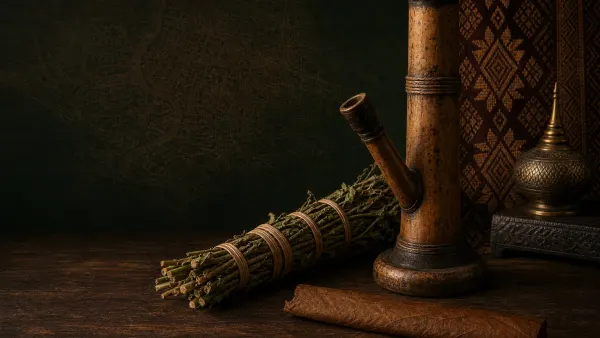
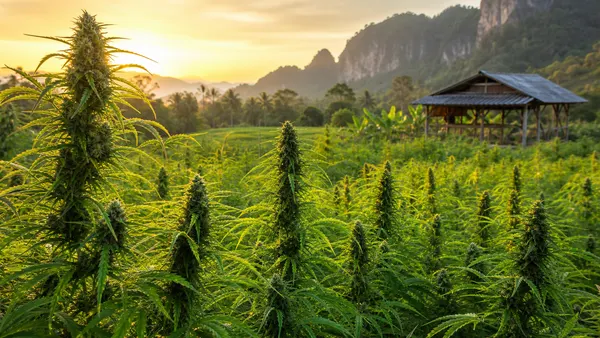
Cannabis cultivation was already established in Isan and the north, and Thai growers had long prepared it as Thai stick — dried buds bound tightly around a bamboo skewer or hemp stalk with fiber, sometimes brushed with hash oil and wrapped in fan leaves to cure. American servicemen encountered it on base and on leave — this was a period when marijuana use among US troops climbed sharply, from around 12% having tried it before deployment in 1966 to a reported 46% by 1970. Most of what troops smoked inside Vietnam itself came from local Vietnamese farmers, under its own regional nicknames like "Pleiku Pink" and "Cambodian Red" — a genuinely separate supply chain from Thailand-grown cannabis, which built its reputation through Thailand postings and Bangkok leave rather than the war zone itself.
By the early-to-mid 1970s, Thai stick had a serious reputation back home, especially on the US West Coast — High Times later credited Thai growers with producing consistent, seedless cannabis years before American growers worked out sinsemilla technique on their own. Exactly how the first sticks made it stateside is genuinely fuzzy: the popular "soldiers mailed it home through military post" story gets repeated constantly but traces back to thin sourcing, and you'll also see unsubstantiated claims about CIA involvement that serious researchers explicitly reject as speculation, distinct from the well-documented (and separate) history of CIA-linked Golden Triangle heroin trafficking. The most substantial documented account of what actually happened is historian Peter Maguire and former smuggler Mike Ritter's 2013 book Thai Stick: Surfers, Scammers, and the Untold Story of the Marijuana Trade, built on hundreds of interviews with the people who ran the trade and the agents who chased it. It describes the business evolving, in their words, "from a GI cottage industry into a professionalized business" over the course of the decade.
That professionalized end is well documented. By the mid-to-late 1970s, operations like the Coronado Company — a crew that started with a group of surfers and college friends from Coronado, California — were moving close to a hundred tons of Thai cannabis and hashish into the US, on margins that made the risk obvious: a ton bought in Bangkok for around $100,000 could reportedly clear $3.5 million stateside. The DEA's investigation, Operation CorCo, produced a grand jury indictment naming 27 people; more than 60 were indicted in total and over 20 did prison time. One member, Louis Villar, pleaded guilty in 1982 to conspiracy to import marijuana, drew a 10-year sentence, and became a government witness.
That's the vector — messier and more contested at the origin than the legend suggests, but well documented once it turned professional — that made Thai weed globally famous in 1970s cannabis culture, and part of why the word "bong" is Thai. The genetics that traveled with it are credited by breeders and strain historians as ancestral stock behind a number of well-known modern lines, including Haze, Chocolate Thai, and Purple Thai. We go deeper on both threads in our history of bongs, blunts, and Thai stick and our piece on Thai landrace genetics.
The genetics didn't all disappear underground, either. On Koh Tao, a longtime local grower and healer known as "KD" — also called "Papa KD" or "Lung Dam" — kept working with Thai cannabis genetics through the decades the plant stayed illegal, and today runs a small family farm near Tanote Bay that's been profiled by both the Bangkok Post and High Times. The exact backstory shifts depending on who's telling it, so we won't repeat the more colorful versions as settled fact. What's solid is simpler and, honestly, more interesting: someone on a small island kept this thread running through the years nobody was supposed to be growing anything at all.
From Category 5 narcotic to dispensary shelf
The short version of what happened next: cannabis stayed criminalized for decades after 1979, came off the narcotics list in June 2022, then moved into a narrower medical framework in 2025 requiring an authorised practitioner's assessment for controlled cannabis flower. We won't relitigate that story here — it's its own post — but as of 2026, a PT33 prescription may be issued only after an independent clinical assessment. Stash BKK can facilitate a telemedicine assessment during a visit; approval and any quantity prescribed remain the practitioner's decision. Stash BKK Chinatown permanently closed on 1 September 2026, after its final trading day on 31 August. The three current Stash BKK locations are On Nut, Ari and Ekkamai; all are open 24 hours. Current addresses and directions. More on the prescription itself in our PT33 walkthrough. Rules here have shifted more than once — worth remembering whatever you read today, including this.
FAQ
When was cannabis first used in Thailand?
There's no single starting date, but documented medicinal use goes back at least to the Ayutthaya-era reign of King Narai (roughly 1656–1688), via a royal compendium of herbal medicine that included cannabis formulas. It was almost certainly part of everyday life well before that — the written record just starts there.
When did cannabis become illegal in Thailand?
Thailand's first cannabis-specific law was the Cannabis Act, commonly dated B.E. 2477 (1934), though its formal Royal Gazette publication falls in 1935. That law was later folded into the Narcotics Act B.E. 2522 (1979), which classified cannabis as a Category 5 narcotic until the 2022 decriminalization.
Is the boat noodle soup cannabis story true?
It's told constantly, including by vendors and chefs themselves, but it's oral tradition rather than documented history — nobody has produced a written record or a reliable date for it. Treat it as folklore, not fact, and be skeptical of anyone citing a specific century.
Why is Thai weed called "Thai stick"?
Thai stick refers to buds bound around a bamboo skewer, a traditional preparation that Thai growers were already using when American servicemen encountered it during the Vietnam War era. It built a legendary reputation in US cannabis culture through the 1970s — the fuller story is in our Thai stick history piece.
Is cannabis legal in Thailand today?
Under the framework in force at this article's 2026 update date, controlled cannabis flower may be dispensed through licensed shops when an authorised practitioner has issued a PT33 after assessment. Stash BKK can facilitate telemedicine, but the practitioner makes the independent decision. Rules have changed more than once since 2022 and could change again, so treat every specific claim as time-stamped rather than permanent.
Did the US ban cannabis in Thailand?
Not directly. Thailand's own 1934/35 Cannabis Act predates the era of heaviest US influence on global drug policy. What the US drove was the 1961 UN Single Convention on Narcotic Drugs, which locked cannabis into the treaty's strictest schedule internationally — Thailand's 1979 Narcotics Act, which consolidated cannabis into its harshest domestic category, was built to align with that treaty framework, alongside separate US pressure on Thailand over Golden Triangle heroin.
How much Thai cannabis was smuggled to the US in the 1970s?
By the late 1970s, professionalized smuggling operations like the Coronado Company were reportedly moving close to 100 tons of Thai cannabis and hashish into the US, on margins steep enough to draw a dedicated DEA investigation that indicted more than 60 people and sent over 20 to prison.