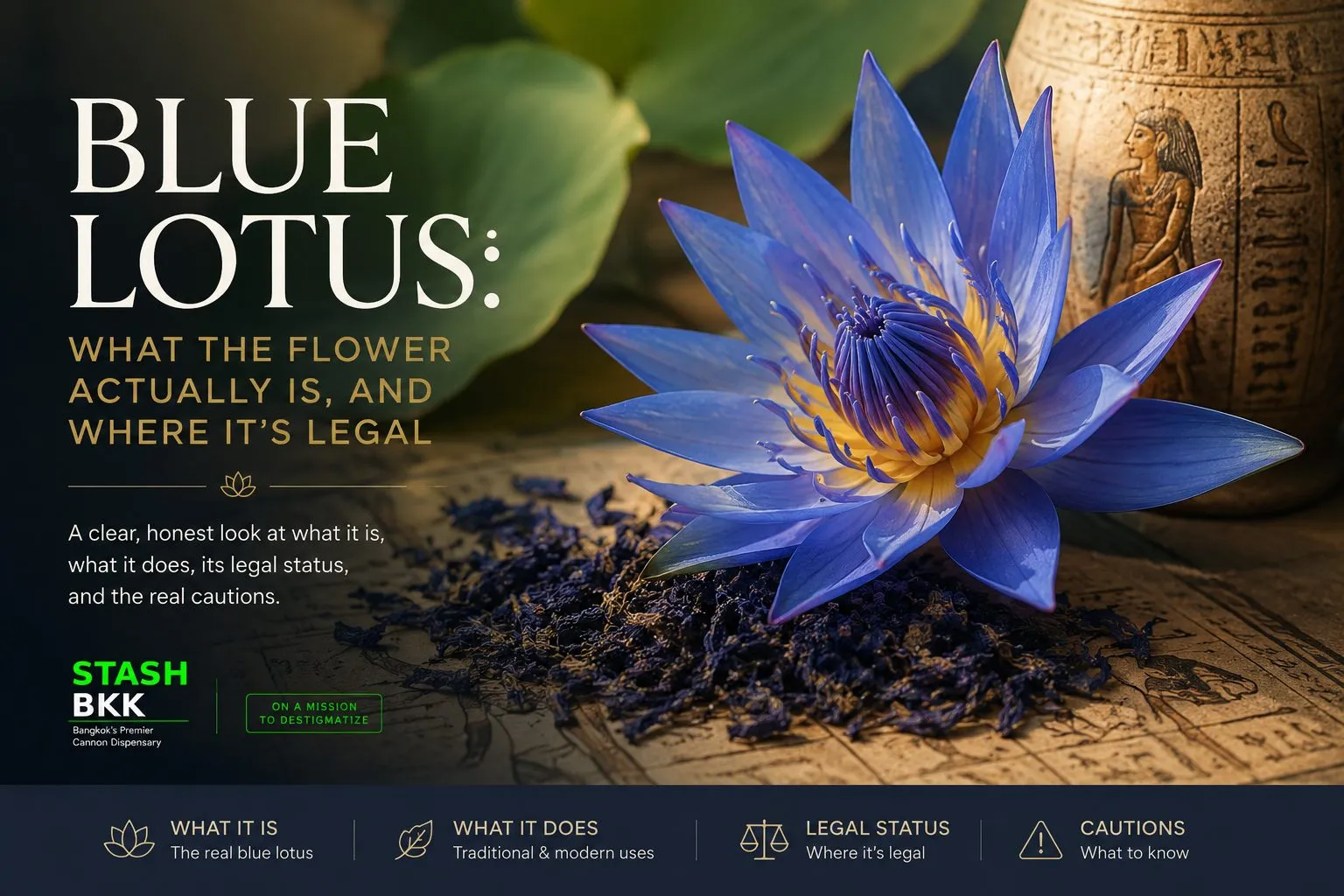
Blue lotus is one of those botanicals that keeps coming back around. It was sacred in ancient Egypt, it shows up in wellness shops and tea blends today, and every so often it has a moment online where everyone suddenly wants to know what it is. So here's a straight, non-hyped look at the blue lotus flower — what it actually is, what people use it for, where it sits legally, and the cautions worth knowing.
One thing up front, because we'd rather be honest than coy: this isn't a product we sell. Stash BKK is a licensed cannabis dispensary, and blue lotus isn't on our shelves. This is an informational piece, part of a wider look at the alternative-botanical landscape, not a sales page.
What Is Blue Lotus?
Blue lotus (Nymphaea caerulea, sometimes called the blue Egyptian water lily) is a flowering water plant, not a true lotus despite the name. It's been used for thousands of years — most famously in ancient Egypt, where it appears all over tomb art and is widely thought to have been used in ceremonial and social settings. That long history is a big part of why people find it interesting: it's one of the oldest documented calming botanicals we know of.
It's typically consumed as a tea, an infusion, or in a wine soak, and sometimes the dried flower is smoked. The active compounds usually pointed to are apomorphine and nuciferine, which is where claims about its effects come from.
What Does Blue Lotus Do?
Reports are consistent on one thing: the effect is mild. People describe a gentle, calming, slightly dreamy or relaxed feeling — closer to a soft wind-down than anything dramatic. It is not a psychedelic, and the experience people describe is subtle rather than intense.
It's worth being clear-eyed here. The rigorous clinical research on blue lotus in humans is limited — most of what's said about it leans on traditional use and anecdote rather than large modern trials. That doesn't make it worthless, but it does mean the honest framing is "long traditional history, gentle reported effect, thin modern evidence base," not "proven to do X." Anyone selling it as a miracle is overselling.
Blue lotus has a genuinely ancient history and a mild, calming reputation — but the modern clinical evidence is thin. Treat confident health claims about it with the same skepticism you'd apply to any lightly-studied supplement.
Is Blue Lotus Legal?
Do not reduce the legal question to whether the plant name appears on a controlled-substance list. The legality of a blue-lotus tea, extract, vape, food, supplement, import, health claim, or sale can depend on the exact product and the country's food, medicine, consumer-protection, customs, and smoking rules.
This page has not established Thai approval for any blue-lotus product or use. Before buying, importing, consuming, or selling one in Thailand, verify the exact ingredient, product registration, label, and intended-use status with the relevant Thai authority.
Where Blue Lotus Sits Among Legal Botanicals
Blue lotus is one of a cluster of legal, traditionally-used botanicals that sit outside the cannabis conversation — alongside things like kratom, damiana, kava, and others. People explore them for the same broad reason: a gentle, plant-based wind-down without the legal complexity that cannabis carries in many places. None of them are a substitute for medical care, and the evidence base varies a lot from one to the next.
We'll cover more of these individually over time — this is the start of a wider look at the alternative-botanical landscape rather than the whole map in one post.
Cautions Worth Knowing
A few sensible notes, none of which are medical advice:
- Don't mix blindly. Combining any botanical with alcohol, medications, or other substances changes the picture. If you take prescription medication, that's a conversation for a doctor, not a forum.
- Driving and operating machinery. Anything with a calming or sedating effect doesn't belong behind the wheel.
- Pregnancy and existing conditions. The lightly-studied nature of blue lotus is exactly why caution is warranted here — when evidence is thin, the conservative call is to abstain.
- Source matters. With any lightly-regulated botanical, quality and accurate labelling vary. An unknown source is an unknown product.
FAQ
Is blue lotus a drug?
It is a traditionally used botanical, not psilocybin. That does not establish that every blue-lotus product, preparation, import, or intended use is lawful or approved.
Does blue lotus get you high?
People describe a gentle, calming, slightly dreamy feeling rather than anything strong or intoxicating. The effect is consistently reported as subtle. It is not comparable to cannabis or to psychedelics.
Is blue lotus legal in Thailand?
This page does not make a blanket Thai-approval claim. Check the exact product's ingredient, food or supplement, import, label, and intended-use status with the relevant Thai authority.
Does Stash BKK sell blue lotus?
No. Stash BKK is a licensed cannabis dispensary; blue lotus isn't a product we carry. This article is purely informational, part of a broader look at alternative botanicals.
Is there real scientific evidence for blue lotus?
The modern clinical evidence in humans is limited. Most of what's said about blue lotus rests on its long traditional use and anecdotal reports rather than large trials. Treat strong health claims with appropriate skepticism.