Kava bars have been popping up everywhere — Bangkok included, in a small but growing way — pitched as the place you go when you want to relax, be social, and skip the hangover. The pitch is "an alcohol alternative," and for a lot of people that's exactly what it delivers. So here's the straight version of what kava actually is, where it comes from, what it does, and the caution that's worth knowing before you write it off as risk-free.
One thing up front, because we'd rather be direct than coy: this isn't a product we sell. Stash BKK is a licensed cannabis dispensary, and kava isn't on our shelves. This is an informational piece, part of a wider look at the legal, non-cannabis relaxation-botanical landscape, not a sales page.
What Is Kava?
Kava (Piper methysticum) is a plant in the pepper family, native to the islands of the South Pacific. The part that matters is the root — it's ground, mixed with water, and strained into a drink that's been central to Pacific Island social and ceremonial life for centuries, long before anyone was calling it a "wellness trend."
The active compounds are a group of molecules called kavalactones, concentrated in the root. They're what's behind kava's calming, muscle-relaxing effect, and they're also why quality and plant part matter so much — more on that in the safety section below.
Traditional Use in Fiji, Vanuatu, and the Pacific
In Fiji, Vanuatu, Tonga, Samoa, and across much of the Pacific, kava isn't a novelty — it's a fixture of daily and ceremonial life. In Fiji it's called yaqona, and sharing a bowl of it is a standard part of hospitality, welcome ceremonies, and community gatherings, right down to the formal sevusevu presentation of kava root as a gift of respect when visiting a village. In Vanuatu, which many regard as kava's likely origin point, kava bars ("nakamals") have long been an everyday part of village and town life, not a tourist gimmick.
The point of kava in these settings has never really been to get intoxicated. It's a social lubricant in the truest sense — something shared in a circle, passed around, that eases conversation and marks an occasion, from casual evenings to formal diplomacy between chiefs. That communal, unhurried framing is a big part of what today's kava bars overseas are trying to recreate.
How Is Kava Prepared and Consumed?
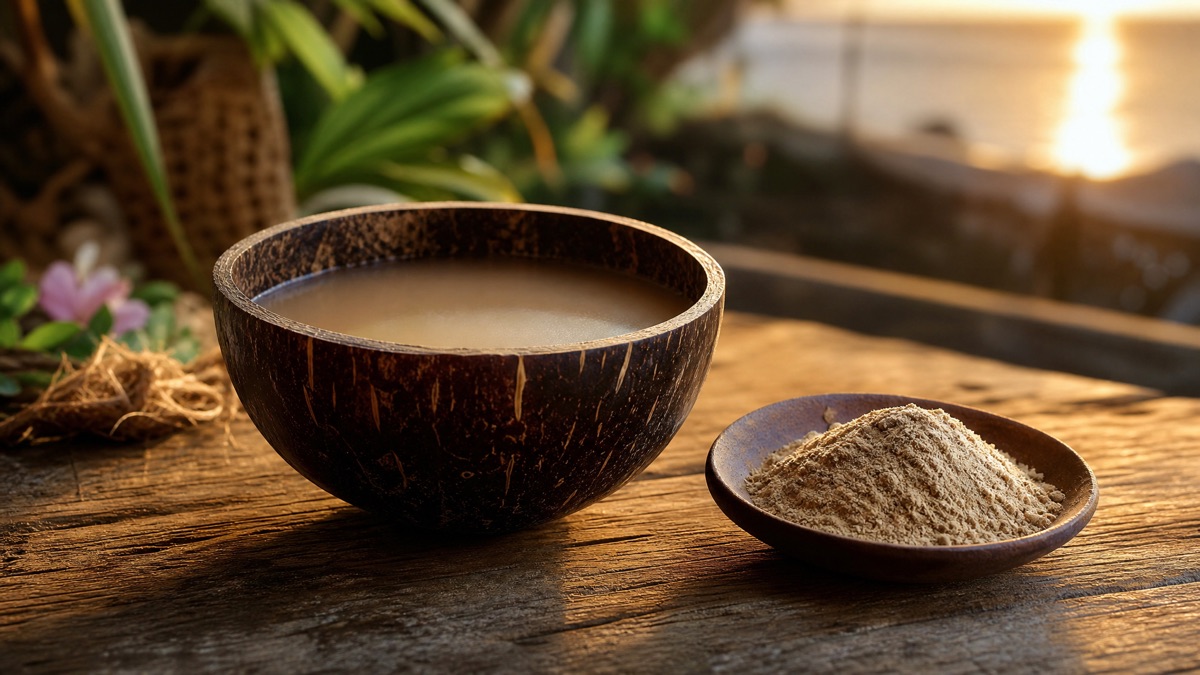
Traditionally, the dried root is pounded or ground into a fine material, mixed with cold water, and kneaded or strained (historically through plant fibre, today more often a cloth or fine strainer) to produce a murky, earthy-tasting liquid. It's served in a communal bowl — a tanoa in Fiji — and drunk from a coconut shell cup, often downed in one go, followed by a clap and a call of "bula" or similar.
Modern kava bars follow a simplified version of the same idea: kava root powder (or a pre-extracted concentrate) is mixed with water, strained, and served in a shell or cup. Most people describe the taste as earthy, bitter, and something you get used to rather than crave — nobody's ordering it for the flavour. A distinctive, harmless side effect is a mild numbing or tingling of the lips and tongue shortly after drinking, caused by the kavalactones themselves.
Kava is a Pacific root with a long traditional-use history. Reported effects vary, impairment is possible, and it should not be promoted as a risk-free or hangover-free substitute for alcohol.
What Does Kava Feel Like? (Not a High)
This is the part people misunderstand most, especially coming from a cannabis or alcohol frame of reference. Kava's kavalactones work primarily by modulating GABA activity in the brain — the same general neurotransmitter system that alcohol and anti-anxiety medications touch, though through a different mechanism. The result, at normal social doses, is:
- Mild sedation — a calm, unwound feeling rather than drowsiness or grogginess
- Muscle relaxation — a physical loosening, often felt in the shoulders and jaw first
- Sociability and ease — reduced social anxiety, more relaxed conversation, without slurred speech or lost coordination at normal doses
- Mental clarity — most users report staying clear-headed rather than foggy or impaired, which is the core of the "alcohol alternative" pitch
Effects, impairment, and next-day symptoms can vary with the preparation, amount, other substances, medicines, and the individual. Do not drive or combine kava with alcohol or sedating medicines. The US NCCIH kava overview summarises the limited evidence, liver-injury reports, and interaction risks.
Is Kava Legal in Thailand?
Kava is outside the cannabis PT33 framework, but that does not make every kava drink, extract, supplement, import, health claim, or method of sale automatically lawful in Thailand. Food, supplement, ingredient, import, labelling, advertising, and premises rules can apply to the exact product. Verify its current Thai FDA status and label rather than relying on a blanket “legal and unregulated” claim.
The Liver Question: An Honest Safety Note
We're not going to bury this or oversell it — here's the straight version. In the early 2000s, kava went through a genuine safety scare. Reports of liver toxicity, including some serious cases, led several European countries (Germany prominent among them) to restrict or ban kava products, and the US FDA issued a consumer advisory flagging the risk. That history is real and worth knowing.
The follow-up research since then has added useful nuance, without erasing the caution. Investigators found that many of the problem cases involved poor-quality products — extracts made with ethanol or acetone rather than the traditional water-based preparation, or products using the whole plant (including stems and leaves, which carry a different and more liver-toxic alkaloid) rather than root alone. Traditional, water-based, root-only kava consumed across the Pacific over centuries hasn't shown the same rate of serious liver problems, which is part of why Germany's ban was later overturned by a court that found the evidence didn't support a blanket restriction.
The honest, unresolved takeaway: kava is not risk-free, root-only water-based preparation appears meaningfully safer than poor-quality extracts, and moderation matters a lot more here than with most "wellness" botanicals. Occasional, social, root-based kava is a different risk profile than daily heavy use of an unknown extract — but "different risk profile" is not the same as "no risk." Treat it with the same respect you'd give any substance that affects the liver, and if you drink regularly, that's a reason to be more cautious with kava, not less.
Kava vs Cannabis: How They Compare
People increasingly mention kava and cannabis in the same breath, but they are different products with different evidence, risks, and regulatory requirements. They are not interchangeable.
- Different mechanism. Cannabis works through the endocannabinoid system (CB1/CB2 receptors), producing psychoactive effects that range from euphoria to altered sensory perception depending on dose and strain. Kava works primarily through GABA modulation — closer in mechanism to how alcohol or anti-anxiety medication touch the brain, minus the impairment and toxicity profile of alcohol.
- Different experience. Cannabis alters perception, mood, and often appetite, and can range from energising to deeply sedating depending on the strain. Kava stays in a narrower, more physical lane — relaxed muscles, eased social anxiety, a calm mind, no perceptual shift, no high to titrate.
- Different legal framework in Thailand. Controlled cannabis flower may require a PT33 medical prescription. Kava is outside PT33, but the exact product may still be subject to Thai food, supplement, import, labelling, and advertising rules.
- Different risk profile. Cannabis has its own well-documented cautions (see our piece on cannabis and anxiety). Kava's main documented caution is liver-related with heavy or prolonged use, as covered above. Neither is "safer" in some universal sense — they're just different substances with different downsides.
The reason they get grouped together isn't that they do the same thing. It's that both fit a broader shift toward substances people choose deliberately, in moderation, for a specific effect — rather than reaching for alcohol by default. Whether that's a puff of flower after work or a shell of kava with friends, the mindset is the same even though the pharmacology isn't.
Where Kava Sits Among Legal Botanicals
Kava is one of a cluster of legal, traditionally-used botanicals that sit entirely outside the cannabis conversation — alongside things like kratom and blue lotus. People explore them for a similar broad reason: a plant-based way to unwind that doesn't carry the psychoactive weight (or in cannabis's case, the prescription requirement) of THC. None of them are a substitute for medical care, and the evidence base and safety profile vary a lot from one to the next — kava's liver caution has no real equivalent in blue lotus, for instance, so it's worth treating each on its own terms rather than lumping them into one "natural relaxant" category.
FAQ
Does kava get you high?
No. Kava produces mild sedation, muscle relaxation, and social ease without the euphoria or altered perception associated with a cannabis or alcohol high. Most users describe staying clear-headed throughout.
Is kava legal in Thailand?
Kava is outside the cannabis PT33 framework, but legality is product- and use-specific. Verify the exact product's Thai FDA, ingredient, import, label, and sale status before relying on a general claim.
Does Stash BKK sell kava?
No. Stash BKK is a licensed cannabis dispensary; kava isn't a product we carry. This article is purely informational, part of a broader look at legal relaxation botanicals.
Is kava bad for your liver?
Kava carries a genuine, documented liver-toxicity risk, particularly with heavy, prolonged, or daily use, or with poor-quality extracts made from non-root plant parts. Traditional, water-based, root-only preparation appears safer, but it's not risk-free — avoid combining kava with alcohol, don't use it heavily or daily long-term, and skip it if you have existing liver issues.
Is kava the same as cannabis?
No. They work through completely different mechanisms — kava through GABA modulation, cannabis through the endocannabinoid system — and produce different experiences. Kava doesn't alter perception or produce a high; cannabis does. They're not interchangeable, even though both get used for relaxation.
Why is kava being called an alcohol alternative?
Because it delivers a comparable social effect — relaxation, eased conversation, lowered social anxiety — without alcohol's impairment, intoxication curve, or hangover. That's the core of the global "kava bar" trend and the sober-curious movement it's tied to.