Walk into a wellness café in Bangkok these days and there's a decent chance the coffee menu has a mushroom option sitting next to the flat whites. Lion's mane, reishi, and cordyceps have gone from niche traditional-medicine ingredients to a genuine mainstream category — coffee blends, capsules, powders, gummies, the lot. This is a straight, no-hype look at what each one actually is, what the evidence says, how people take them, and where they sit legally.
Lion's mane, reishi, and cordyceps are different species from psilocybin mushrooms and are not sold for psychedelic effects. That distinction does not mean every extract, food, supplement, import, label, or health claim is automatically approved. See our separate psilocybin legality article.
What "Functional Mushrooms" Actually Means
"Functional mushroom" is a marketing-friendly umbrella term for a handful of fungi that have a long history in traditional medicine — mostly Chinese and Japanese — and are now sold in the West and across Asia as food and dietary supplements rather than as medicine. They're not intoxicating, not controlled, and not related in any way to the psychoactive species. The three that show up constantly are lion's mane, reishi, and cordyceps, each associated with a different, specific use case rather than one vague "wellness" claim.
Lion's Mane — Focus and Nerve Growth
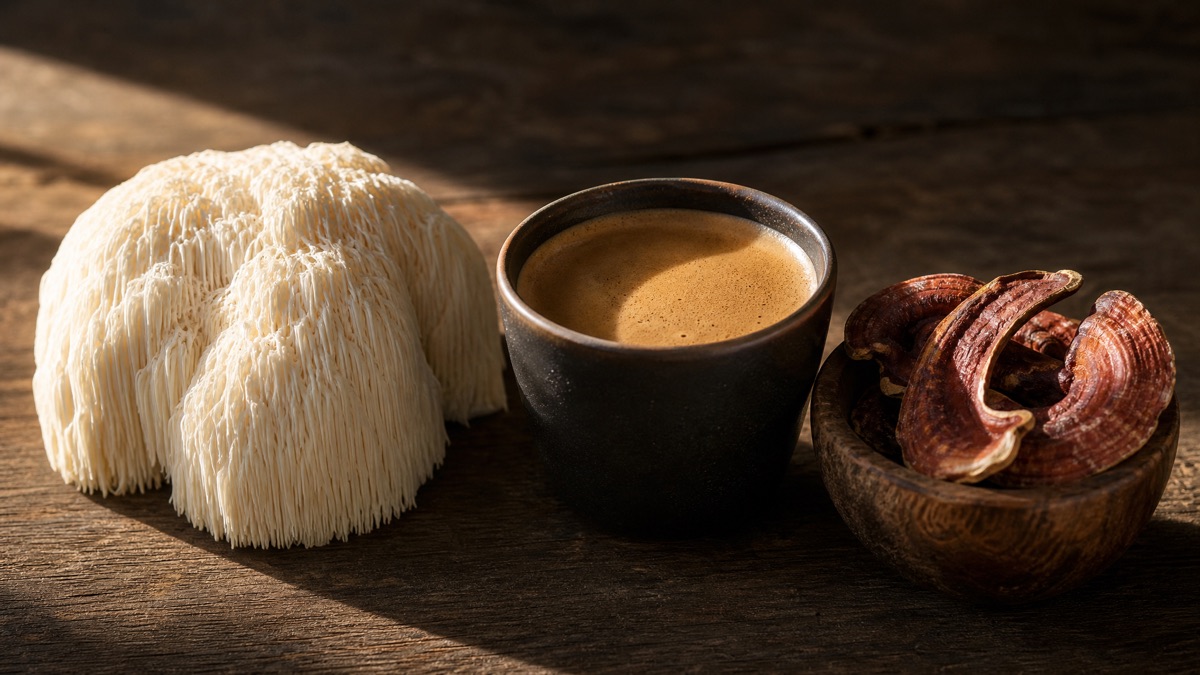
Lion's mane (Hericium erinaceus) is the shaggy, white, almost coral-looking mushroom you'll see in gourmet cooking as much as in supplement form. It's the one most associated with cognition, and the reason is specific: lion's mane contains compounds called hericenones and erinacines, which lab and animal studies suggest may stimulate the synthesis of nerve growth factor (NGF) — a protein involved in the growth and maintenance of nerve cells.
That's genuinely interesting science, but it's worth being precise about where it stands. Most of the strong NGF evidence is preclinical — cell cultures and animal models, not humans. The human data is thinner: a small, often-cited Japanese trial gave older adults with mild cognitive impairment a lion's mane supplement for several weeks and found cognitive scores improved during the trial, then drifted back down after people stopped taking it. That's a promising signal, not proof — the study was small, short, and hasn't been reproduced at scale. "Being researched for cognition" is accurate. "Proven to boost your brain" is not.
Reishi — Calm and Immune Support
Reishi (Ganoderma lucidum) has been used in Chinese medicine for over two thousand years, sometimes called the "mushroom of immortality." It's a hard, woody, almost lacquered-looking fungus, and it's typically consumed as an extract rather than eaten fresh. Reishi contains beta-glucans (polysaccharides) and triterpenes, and modern research has looked at both for immune modulation, with some smaller studies also exploring effects on sleep quality and stress.
The honest caveat here is bigger than with lion's mane. Reishi has by far the longest traditional-use history of the three, but the modern clinical trial base is uneven — a 2016 Cochrane review looking specifically at reishi and cancer outcomes, for instance, found the existing human trials too small and poorly designed to draw firm conclusions, and recommended against relying on it as a primary treatment. That doesn't erase the traditional-use case or the immune-modulation research entirely, but it does mean reishi belongs in the "long history, real ongoing research, not a proven treatment for anything" bucket — not a cure-all.
Cordyceps — Energy and Endurance
Cordyceps is the strangest origin story of the three. Wild cordyceps (Ophiocordyceps sinensis) is a fungus that grows in the Himalayas and on the Tibetan plateau by infecting ghost moth caterpillars, consuming them from the inside, and eventually sending a stalk up out of the caterpillar's head. It's been used in Tibetan and Chinese medicine for centuries for energy and stamina, and because wild specimens are rare and labour-intensive to collect, they can sell for thousands of dollars per kilogram.
Almost nothing sold as a "cordyceps supplement" today is the wild caterpillar fungus. Nearly all commercial products use lab-cultivated Cordyceps militaris or a fermented mycelium strain (often labelled Cs-4), grown on grain rather than harvested from a caterpillar — chemically similar in the compounds researchers care about, at a fraction of the cost, and without the sourcing and sustainability problems of the wild version. Research has focused on cordycepin and its effects on ATP production and oxygen utilisation, which is the basis for the "endurance" reputation. Some small trials show modest improvements in exercise capacity, particularly in older or untrained adults; several trials in already-trained athletes have failed to show a real edge over placebo. Promising, mixed, not a guaranteed performance boost.
How People Actually Take Them
Format matters more than people expect, because the compounds researchers care about split roughly into two groups: water-soluble ones like beta-glucans, and alcohol-soluble ones like reishi's triterpenes. A proper extract uses both hot water and alcohol — "dual extraction" — to pull out both. Plain ground mushroom powder in a capsule, with no extraction step, may deliver a lot less of the active compounds than the label implies. It's worth knowing that distinction if you're comparing products rather than just brands.
- Mushroom coffee — instant coffee blended with mushroom extract powder, often with less caffeine than a regular cup, marketed as a smoother energy curve without the crash.
- Capsules — standardised extract, the easiest format to dose consistently day to day.
- Powders — loose extract stirred into coffee, tea, or a smoothie; usually the most flexible and cheapest per serving.
- Gummies — the most convenient, no prep needed, though check the label — dose per gummy is often lower than a capsule serving, and there's added sugar.
What the Research Actually Says, Honestly
Across all three mushrooms, the pattern is the same: genuinely interesting preclinical science, a traditional-use history that's real but not clinical proof, and human trials that are small, short, and not yet at the scale where a doctor would prescribe them for a specific condition. These are dietary supplements, not medicine — regulators evaluate them as food, not drugs, which means potency and quality claims on packaging aren't independently verified the way a pharmaceutical's would be. None of this is medical advice, and none of it replaces actual treatment for a real condition.
Are Functional Mushrooms Legal?
Non-psychoactive mushroom species are different from psilocybin, but “fully legal” is too broad for a finished product. Thai food, supplement, ingredient, import, manufacturing, labelling, advertising, and health-claim rules may apply to the exact coffee, capsule, powder, gummy, or extract. Verify the label and current Thai FDA status of the specific product.
If You Want to Go Deeper
If you'd rather see functional mushrooms actually being grown than just read about them, our friends at Earthling BKK run a working mushroom farm on On Nut 17 (Yaek 20) — walking distance from our own On Nut branch. Founded by American brothers Alex and Sam Turner, they grow lion's mane, cordyceps, and reishi alongside fresh gourmet varieties, and supply restaurants across Thailand, including Michelin-starred kitchens. Beyond fresh, same-day-shipped mushrooms, they sell mushroom coffee, capsules, powders, and a lion's mane–cordyceps–reishi gummy blend, and they run a bookable "you pick" farm tour if you want to see the growing process firsthand. Worth a look if any of this has you curious — find them at @earthling.bkk on Instagram. (To be clear: no formal partnership between Stash BKK and Earthling BKK — just a genuinely good local resource in the same neighbourhood.)
One honest note before the FAQ: Stash BKK is a licensed cannabis dispensary. Functional mushrooms aren't a product we carry or sell — this article is purely informational, part of a broader look at the legal botanical and alternative-wellness landscape alongside pieces like our guide to blue lotus.
FAQ
Are functional mushrooms the same as magic mushrooms?
No. Lion's mane, reishi, and cordyceps are different species from psilocybin mushrooms and are not sold for psychedelic effects. Finished products still need to follow the rules that apply to their ingredients, form, label, import, and claims.
What does lion's mane actually do?
It's studied for its potential to support nerve growth factor (NGF) activity, which is why it's associated with cognition and focus. The strongest evidence is preclinical; human trials are small and promising rather than conclusive. It's not a proven cognitive enhancer.
Is reishi good for sleep and immunity?
It's traditionally used for exactly that, and modern research has looked at its beta-glucans and triterpenes for immune modulation and stress. The human clinical evidence is real but uneven in quality — a long traditional history doesn't equal clinical proof.
What is cordyceps used for?
Mainly energy and exercise capacity, via its effect on ATP production and oxygen use. Most commercial cordyceps is lab-cultivated, not the rare wild Himalayan fungus. Some trials show modest benefits, especially in untrained adults; results in trained athletes are mixed.
Are functional mushrooms legal in Thailand?
Do not rely on a blanket category claim. Check the exact product's Thai FDA, ingredient, food or supplement, import, labelling, and advertising status.
Does Stash BKK sell functional mushrooms?
No. Stash BKK is a licensed cannabis dispensary. Functional mushrooms aren't something we stock or sell — this is an informational article, not a product page.
Where can I find functional mushrooms in Bangkok?
They're widely available at wellness cafés, health food stores, and online. For a local resource that actually grows them here — including a farm tour — our friends at Earthling BKK in On Nut are a solid place to start.