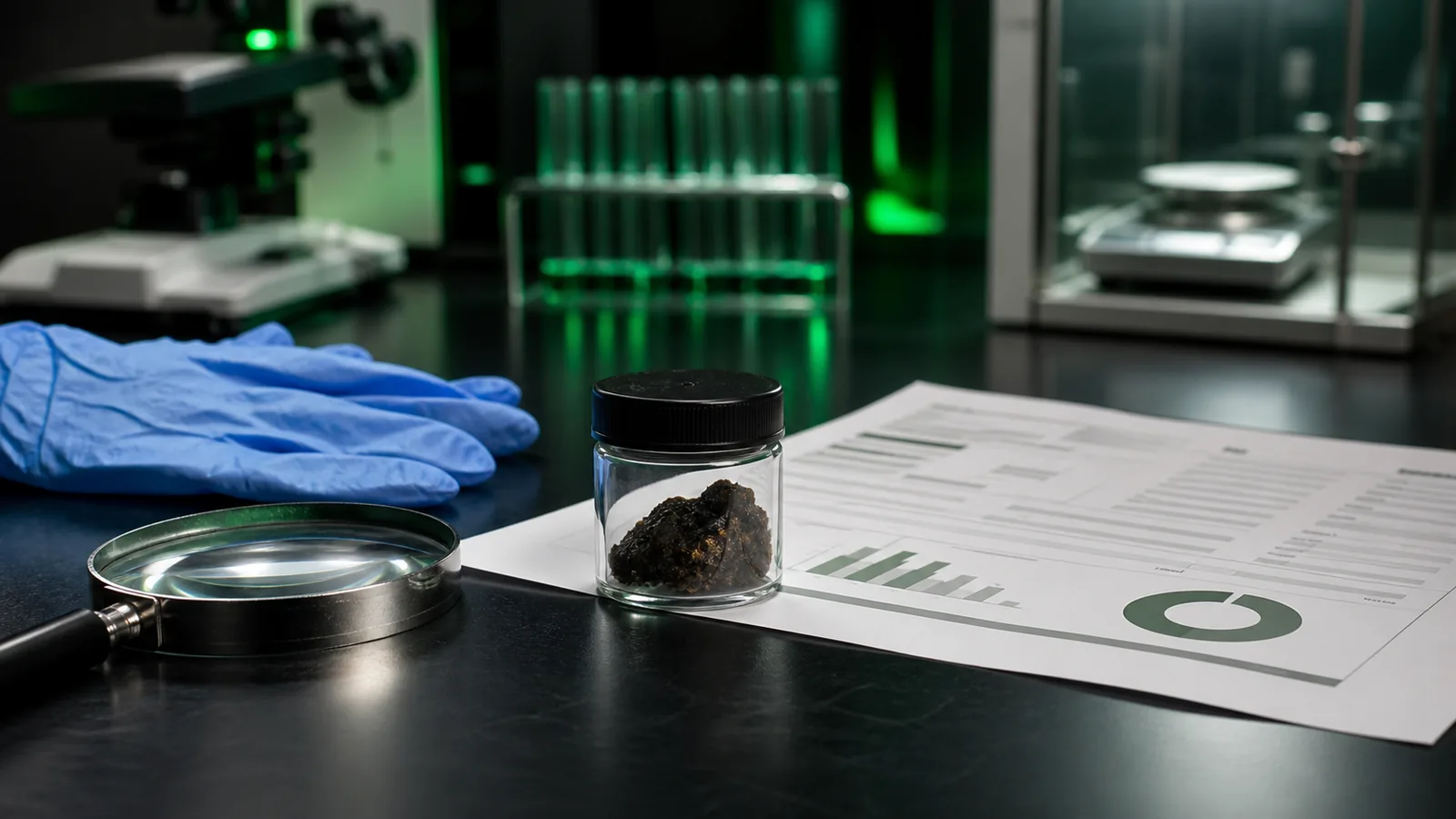
People searching for hash in Bangkok often expect a simple yes-or-no answer. Thai law does not turn on the English nickname, the colour of the material, or whether somebody calls it “traditional,” “solventless,” or “CBD hash.” The important questions are what the product legally is, how it was made, its THC concentration by weight, where it came from, and which authorizations cover it.
“Hash” is not the legally decisive label
Hash or hashish is commonly used as an umbrella term for concentrated resin or trichome material. That market language is not enough to classify a particular sample under Thai law.
Official Thai guidance instead distinguishes cannabis flower, extracts, medicines, herbal products, foods, cosmetics, and other regulated product categories. Current rules for cannabis and hemp extraction cover both solvent and non-solvent extraction methods. A “solventless” claim therefore does not automatically place a resin product outside extract controls.
The same caution applies in the other direction: this article cannot classify every compressed or resinous material as an extract. That determination depends on the facts of the product and, where necessary, the Thai authorities responsible for the applicable law.
The four questions that actually matter
1. Is the material legally an extract?
The name on a menu is not the answer. Manufacturing method, composition, intended use, and product registration can all affect classification. A seller changing the label from “extract” to “hash” does not change the underlying material.
2. What is the THC concentration by weight?
DTAM’s current guidance states that cannabis or hemp extracts containing more than 0.2% THC by weight remain Category 5 narcotics. The relevant evidence is a result for the exact batch—not a verbal estimate, a strain name, or a report for another product.
DTAM’s current FAQ also says that possession of an extract from cannabis flower is not an offence only when the extract is below the applicable 0.2% THC threshold; above that threshold, narcotics controls apply. The FAQ adds that the extractor must have the relevant Thai FDA authorization.
3. Was the extraction and source authorized?
The threshold is not a stand-alone loophole. The Office of the Narcotics Control Board’s official English summary of Thailand’s framework explains that the exemption for an extract at or below 0.2% THC depends on authorized extraction from cannabis or hemp cultivated in Thailand. Imported extracts and cross-border movement have separate permission requirements.
DTAM’s 2026 factory guidance also requires traceability when controlled cannabis flower enters processing. It describes separate permissions and records for the flower source, processing, extraction, testing, and movement of the resulting material.
4. Which product law applies?
An extract used in a medicine, registered herbal product, food, or cosmetic can be governed by that product’s own law in addition to cannabis and narcotics controls. DTAM says products made with an extract at or below the threshold still require the relevant production authorization and registration with the Thai FDA.
That is why “under 0.2%” and “CBD” are not complete legal answers. The product category, approved formulation, label, producer, source, and registration still need to line up.
A cannabis-flower licence is not proof for extracts
A Bangkok shop may be authorized to sell controlled cannabis flower. That does not, on its own, prove that an unidentified resin or extract is covered.
The Thai FDA maintains distinct licence pathways for producing, importing, exporting, selling, and possessing Category 5 cannabis or hemp extracts. DTAM separately describes the permissions a factory needs to process controlled flower and produce an extract. The practical conclusion is narrow but important: ask for evidence tied to the product, not just evidence that the premises can sell flower.
For a broader retail checklist, read Bangkok weed shop vs licensed dispensary.
What could verify a specific product?
No single photo or menu line can do it. A defensible product file would normally need to connect:
- The exact product and batch or lot identity
- A laboratory result showing THC by weight for that batch
- The producer and relevant production or extraction authorization
- Source and traceability records, including domestic origin when an exemption depends on it
- The applicable sale or possession authority
- Any required medicine, herbal-product, food, or cosmetic registration
- Medical documentation where the product is supplied through a medical pathway
A certificate of analysis is useful only when it matches the exact batch and comes from an identifiable laboratory. It does not replace the producer’s authorization or the product’s registration. See what “medical grade” cannabis actually means for a practical guide to batch records and COAs.
Red flags around “legal hash” claims
Be cautious when any resin or concentrated product is presented with:
- No batch-linked THC result
- No identifiable producer or source
- A claim that “solventless” automatically means legal
- A flower retail licence offered as the only proof
- Foreign packaging but no import documentation
- A “CBD” label with no complete product registration or analysis
- Online or delivery sales claims
- Guaranteed medical effects or no practitioner process
Unknown potency also creates a safety problem, separate from the legal one. Do not rely on colour, softness, smell, or a seller’s description to estimate concentration.
The clearer route: documented cannabis flower
If you are seeking regulated cannabis treatment in Bangkok, the easier product to verify is documented cannabis flower handled through the current in-store process. Check the shop’s controlled-herb licence, the exact flower batch, its source, a matching COA or other test record where available, and the genuine practitioner-led medical process.
At Stash BKK, any required PT33 consultation is arranged by telemedicine during the in-store visit, and the licensed practitioner—not the budtender—makes the medical decision. Stash BKK does not sell hash, hashish, rosin or cannabis concentrates and does not deliver any product. This article is informational.
Use the documented in-store flower process
Compare current branch details and visit in person to ask about the licence, exact flower batch, source records, and applicable medical process.
Find a Stash BKK branch →Official Thai sources
- DTAM: 2026 factory and cannabis-extraction guidance
- DTAM: current cannabis FAQ
- Thai FDA: Category 5 cannabis and hemp extract licences
- Office of the Narcotics Control Board: Thailand’s Cannabis Policy Updates (official English PDF)
Frequently asked questions
Is hash legal in Bangkok?
There is no reliable yes-or-no answer based only on the word “hash.” If the product is legally an extract, its THC concentration, production authorization, source, product category, and other permissions determine its status. An extract over 0.2% THC by weight remains a Category 5 narcotic.
Is CBD hash legal in Thailand?
“CBD hash” is a marketing label, not proof of legality. The exact batch still needs evidence of composition, THC by weight, authorized extraction and source, plus any product registration required for its category.
Does a cannabis dispensary licence cover hash?
Do not assume so. Permission to sell controlled cannabis flower is not proof of authority to produce, possess, or sell a regulated extract. The Thai FDA lists separate licensing pathways for Category 5 cannabis and hemp extracts.
Can I bring hash into Thailand in my luggage?
Do not assume personal luggage is exempt. Import and export of cannabis extracts are separately controlled and can require advance permission. Obtain written confirmation from the Thai FDA or the relevant authority before any cross-border movement.
Can a photo show whether hash is legal?
No. Appearance cannot establish THC concentration, manufacturing method, source, batch identity, or authorization. Those require records and, where applicable, laboratory analysis.
Does Stash BKK sell hash?
No. Stash BKK does not sell hash or hashish, rosin or cannabis concentrates, or vapes or e-cigarettes. Its only cannabis edible is the specific Thai FDA-approved Baked Brand cookie product labelled 1.6 mg THC. Stash BKK is walk-in only and does not deliver any product.
Last reviewed: 7 August 2026. This is general information, not legal or medical advice. Thai rules, licence transitions, and official interpretations can change.


